A tiny home has a fixed floor plan, so every object competes for the same floor space. A robot could change that by moving a bed, table, storage unit, or work surface when the room’s job changes. The useful question is where motion saves space without making daily life harder.
- A wall-mounted mechanism could move furniture out of the way.
- Sensors could check for people, pets, and loose objects.
- Safe manual use must still work when power or software fails.
The room changes instead of growing
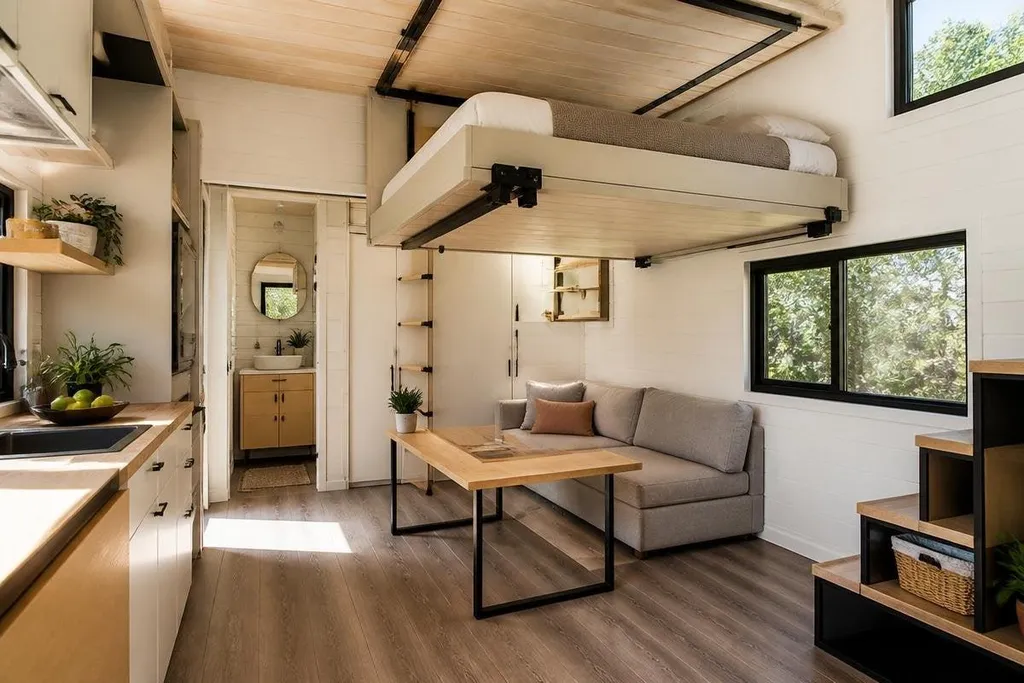
The main idea is shared space. One bed could rise into a ceiling cabinet during the day, then lower at night.
A work surface could fold against a wall after use, while storage could slide into a narrow section beside the kitchen.
Each design needs a motor, a frame, position sensors, and a control system. A linear actuator, which is a motor that pushes or pulls along a straight path, could lift a platform. A robotic arm could move a smaller object between fixed locations.
The movement has to match the object’s weight and shape. A bed needs a different drive system from a shelf carrying books, and both need brakes that hold the load when power stops. The design must also leave room for a person to reach the object by hand.
That last point matters in a home. A moving cabinet that saves floor space but blocks the only exit has created a safety problem, not useful storage.
Where the hardware could help
Sleeping areas offer one clear use. A raised bed could free the main floor during the day, while a lower platform could make the sleeping area easier to reach for someone with limited movement. The robot would need to check that the space below is clear before it moves.
Kitchens have a different need. A lift could bring a mixer or cooking surface to a usable height, then return it to storage. A powered drawer could move heavy pans without asking someone to reach deep into a cabinet. These ideas work best when the robot moves one known load along one known path.
Storage may gain the most from small movements. Shelves could slide forward from a narrow wall cavity, and a ceiling rack could lower seasonal items. A camera or distance sensor could check shelf position, but a person would still need a clear way to inspect, clean, and repair the mechanism.
A moving shelf is useful only if it stays safe, reachable, and serviceable when something jams. Reports from Robot24 can put these home ideas beside the safety and maintenance demands of working robots, which leads to the harder problem: fitting motors, wiring, and access panels inside the walls.
The limits are inside the walls
Every moving part adds weight, wiring, noise, and a repair task. A ceiling bed also needs a frame that can carry the load above a person. That changes the structure of the home and may reduce the space gained elsewhere.
Software brings another concern. A sensor can miss a soft bag, a cable, or a child’s hand. The system should move at low speed near people, stop when its readings disagree, and include a physical release or manual mode.
Power loss needs its own plan. During an outage, the bed should stay supported, and a door or exit should remain usable when the control system is off. Battery backup can help, but it adds cost, weight, and another part that needs checks.
Noise also matters more in a small home. A motor that sounds acceptable in a workshop may wake someone in the same room. Designers need to state the sound level, service interval, load limit, and failure mode instead of treating automation as a silent feature.
A buying and design checklist
Before choosing a moving feature, check these points:
- Name the task: Decide which object needs to move and how often.
- Measure the path: Check the full travel distance, ceiling height, door swing, and exit route.
- Set the load: Include the object, its contents, and any force from a person pulling or pushing it.
- Test power loss: Confirm that the load stops safely and that you can operate the home by hand.
- Plan service: Leave access to motors, cables, sensors, and fasteners.
- Check the sound: Test the mechanism during the hours when people sleep or work.
A useful design gives the floor a second job without turning ordinary tasks into a software problem. I’d spend money on a moving bed or shelf only when its manual backup, load limit, and repair access are clear on paper.
The first practical tiny-home robots will likely move one well-defined load on a fixed path. That is a smaller promise than a room that rearranges itself, but it is the version a builder can inspect, repair, and live with.